
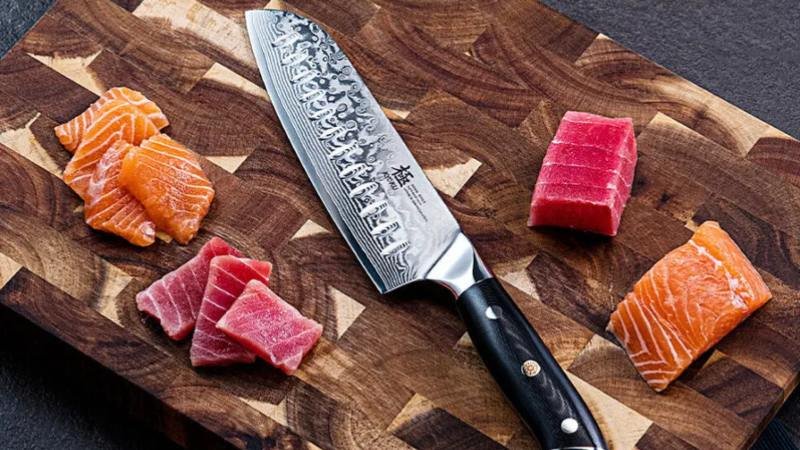
You’ve finally done it. You’ve upgraded to a Kyoku santoku knife. You’ve felt that “laser-like” glide through a ripe tomato, and you’ve marveled at the Damascus ripples on the steel. It’s more than a tool; it’s the soul of your kitchen.
But here’s the direct truth: Japanese steel is a high-performance instrument. Much like a Formula 1 car, it requires specific care to maintain its elite status. If you treat it like a standard hardware-store knife, you’re going to end up with a chipped, dull, or rusted relic.
At Kyoku, we want your legacy to last. Here are the five most common ways people accidentally “break” their Japanese knives—and how you can avoid them.
1. The Dishwasher (The “Death Trap”)
We get it. It’s 10:00 PM, you’ve just finished a three-course meal, and the dishwasher is right there. Don’t do it.
- The Heat: High-temperature cycles can expand and contract the steel, potentially warping the blade or loosening the rivets.
- The Chemicals: Dishwasher detergents are incredibly abrasive. they can pit the steel and dull that 15° edge in a single cycle.
- The Chaos: Jets of water can knock your knife against ceramic plates or metal racks, leading to microscopic chips.
- The Fix: Hand wash with mild soap, dry immediately with a soft cloth, and put it away. It takes 30 seconds.
2. Glass or Stone Cutting Boards
If your cutting board makes a “clink” sound when the knife hits it, you are actively killing your edge.
Japanese steel is hardened to 60+ HRC. This makes it incredibly sharp, but also less flexible than soft Western steel. When that hard edge hits an even harder surface like glass, marble, or granite, the steel has nowhere to go—so it rolls or chips.
- The Fix: Stick to High-Quality Wood (like acacia, walnut, or hinoki) or High-Density Plastic. These materials have “give,” allowing the blade to bite into the board slightly without damaging the edge.
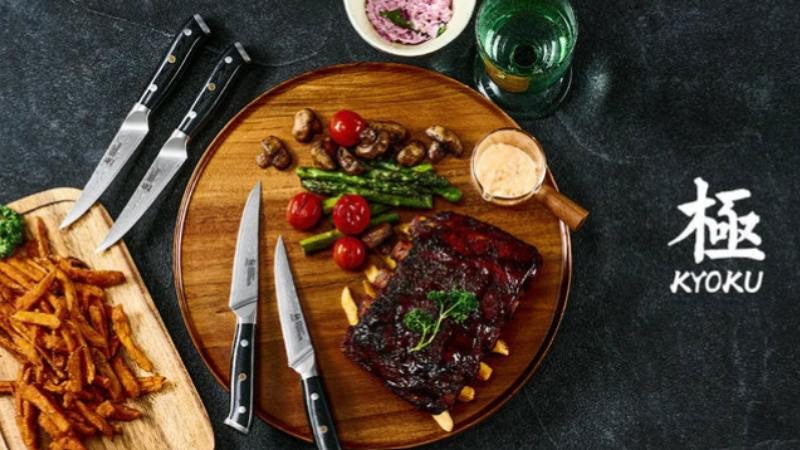
3. The “Bone-Breaker” Mistake
Your Kyoku Santoku is a surgical scalpel, not a meat cleaver. One of the quickest ways to ruin a high-carbon blade is trying to twist it through a chicken joint or hack through frozen corn.
Because the steel is so hard and the edge is so thin, lateral (sideways) pressure is the enemy. If the blade gets stuck in a bone and you “torque” or twist it to get it out, you will see a crescent-shaped chip missing from your edge.
- The Fix: Use a dedicated Butcher Knife or heavy cleaver for bones and frozen items. Save your Kyoku for the precision work it was born for.
4. Drawer Chaos (The “Scabbard” Issue)
A Samurai would never toss his sword into a pile of scrap metal. If you’re throwing your Kyoku knife into a cluttered “junk drawer” with metal spatulas and whisks, you are inviting disaster.
Every time you open and close that drawer, the edge is banging against other metal tools, resulting in “micro-chipping” that you might not see, but you’ll certainly feel the next time you try to slice an onion.
- The Fix: Use a Magnetic Knife Strip, a Knife Block, or a simple Edge Guard (Saya). Protect the edge, and the edge will protect your prep work.
5. Pull-Through “V-Sharpeners”
Those $10 plastic sharpeners with the two metal wheels? They are the “cheese graters” of the knife world. They work by literally stripping away layers of your expensive steel to create a jagged, temporary edge.
For a Japanese knife with a specific 13–15° angle, these sharpeners are too wide and too aggressive. They will eventually grind your beautiful Kyoku blade down into a nub.
The Kyoku Philosophy: Respect the Craft
Owning a high-end Japanese knife is a partnership. If you give it 60 seconds of proper care after each use, it will stay “scary sharp” for years to come. Treat your blade with the honor it deserves, and it will return the favor every time it hits the board.